Glen Haven Association
Your source for documentation, safety suggestions, history, and community updates.
Glen Haven Association
Your source for documentation, safety suggestions, history, and community updates.

Glen Haven is located at 40°27′13″N 105°26′56″W(40.453740,-105.448837). Situated in Roosevelt National Forest east of Rocky Mountain National Park, Fox Creek and West Creek join the downtown Glen Haven, which then flows through Devil's Gulch, receiving Miller Fork, and joins the Big Thompson River at Drake. Larimer County Road 43, the on
Glen Haven is located at 40°27′13″N 105°26′56″W(40.453740,-105.448837). Situated in Roosevelt National Forest east of Rocky Mountain National Park, Fox Creek and West Creek join the downtown Glen Haven, which then flows through Devil's Gulch, receiving Miller Fork, and joins the Big Thompson River at Drake. Larimer County Road 43, the only road access to Glen Haven, takes a northeasterly route out of Estes Park, turning to the southeast near Glen Haven and then follows the North Fork downstream to Drake, where it terminates at US Highway 34. Many of the roads off County Road 43, called Devil's Gulch Road, are privately owned.
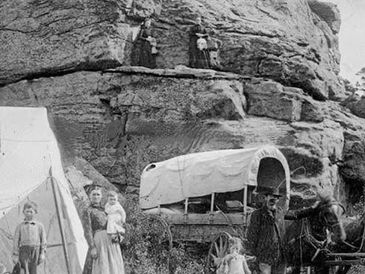
In the early 1890s, the Knapp family from Illinois built a sawmill near Harding Heights, then moved it first to Miller Fork and then to the point now known as Glen Haven in 1897. The Boulder Presbytery, with assistance from the Knapp family, formed an association in 1903 and sold lots for a summer resort called Glen Haven. The associa
In the early 1890s, the Knapp family from Illinois built a sawmill near Harding Heights, then moved it first to Miller Fork and then to the point now known as Glen Haven in 1897. The Boulder Presbytery, with assistance from the Knapp family, formed an association in 1903 and sold lots for a summer resort called Glen Haven. The association built the Glen Haven General Store in 1921.[4] Under the direction of Ira Knapp, a lodge-style hotel was built called The Homestead, and opened in 1938. The Homestead became known as the Inn at Glen Haven and was mentioned in a Los Angeles Times travel article in 1986. The Trail's End camps of Cheley Colorado Camps are also located near Glen Haven.
Glen Haven's location in a narrow valley puts the area at risk for flooding. The Big Thompson Flood of 1976 moved the town hall several feet off its foundation. In September 2013, approximately 80 percent of Glen Haven's downtown was destroyed in the 2013 Colorado floods. Access to the town was cut off by the destruction of Larimer County Road 43 on both sides of town; the section connecting to the town of Drake and US 34 was reopened on December 6, 2013
Contact Sandy Grice to make an appointment to visit The Glen Haven Historical Society museum for much more history and hear some local lore.

---------------Did you know -------------------
The Glen Haven Historical Society has a small Museum in Town Hall displaying thousands of interesting artifacts from Glen Haven's past.
Sandy Grice is available and happy to meet with you by appointment and share images and the lore of Glen Haven. Contact Sandy at 970-#####
We are digitizi
---------------Did you know -------------------
The Glen Haven Historical Society has a small Museum in Town Hall displaying thousands of interesting artifacts from Glen Haven's past.
Sandy Grice is available and happy to meet with you by appointment and share images and the lore of Glen Haven. Contact Sandy at 970-#####
We are digitizing and building a website so everyone can visit Glen Havens Colorful past... ...and we need volunteers.
There are thousands of images, books, documents and physical items to be digitally photographed...
...and we need volunteers.
Sandy will be organizing fun gatherings to start this important mission...
...and we need volunteers.
Join Sandy and have fun preserving our history for future generations.

GHAVFD currently has 17 active members, 4 support members, and one junior trainee.
GHAVFD has responded to 43 calls in 2025 as of 11/1/25.
2025 has been a great year for the department. We have two more members that attended fire academy and are now interior qualified structure firefighters and one member that just completed their initial EMR (Emergency Medical Responder) training. We continue to train and have cumulatively as a department trained over 1,000 hours in 2025. We were able to purchase 4 new gas monitors, a wild-land skid for the UTV, and some other miscellaneous hoses and appliances that will make our responses even better.
The Glen Haven area is once again a FireWise community. Thank you to all who have taken the initiative to perform fire mitigation around their homes and properties.
The department looks forward to continuing working with the residents and Big Thompson Watershed Coalition with fire mitigation projects/defensible space around homes. We plan to conduct more pile burns this winter on the GH association land.
The Glen Haven CWPP (Community Wildfire Prevention Plan) will be getting its update this fall/winter with input from surrounding agencies/stakeholders. Once a draft has been made the associations will be notified and public comment can be made at that time.

The auxiliary is looking to make some changes in 2026 – watch for a website and Facebook page for all the latest information. We hope to have a link on the the fire department website.
We are also looking for new members to join the auxiliary. We meet March – August with the pancake breakfast being a major part of our effort. We also support the fire department with the organization of food in the case of a fire incident and help with an appreciation dinner for the department. All are welcome, with full-time, or part-time residents encouraged to reach out.
Barb Eversoll 303-638-6213 or email ghfire.auxiliary@gmail.com

You can be a hero by doing wildfire mitigation around your home. Many home insurers require compliance with the Colorado State Forest Service guide to defensible space. Please do your best to understand these strategies for wildfire mitigation, and implement them on your property.
Town Hall
Come join the Fun with good neighbors, good food and holiday cheer
Bring a dish etc..
Town Hall
Fire House
Benefits GHAVFD ETC....
Fire House
Fire House
Get involved in your this most important part Glen Haven.
Attend a board meeting and see how you can aid your community.
Fire House
Town Hall
Keep up with your communities efforts
Voice Your concerns
Make suggestions
Visit with all your neighbors
Town Hall

Mountain Lions, Risk, and Responsibility in the Outdoors
By Jason Marsteiner – Owner/Founder The Survival University
I'm not trying to scare people away from the outdoors. I actually want more people out there. We need nature. We need that connection. We need to step away from s
Mountain Lions, Risk, and Responsibility in the Outdoors
By Jason Marsteiner – Owner/Founder The Survival University
I'm not trying to scare people away from the outdoors. I actually want more people out there. We need nature. We need that connection. We need to step away from screens, stress, and constant distractions and remember what it feels like to be human again.
But wanting people outside also means being honest about how the outdoors actually works.
Wildlife encounters like this are rare, but they are not impossible. Mountain lions are not monsters and they are not out hunting people for sport. They are predators doing predator things in environments that are changing rapidly around them.
As more people move into remote and semi remote areas, wildlife gets pushed out of its traditional habitat. At the same time, prey animals get displaced or reduced, which forces predators to cover more ground and take more risks. Add to that animals becoming more accustomed to seeing humans, and encounters become more likely. Take in the reintroduction of a new apex predator, the wolf, and now the mountain lions have to compete for food.
That’s not political. That’s ecology.
I’ve been teaching survival professionally for about 15 years. When I started, maybe 10% of my students were women. Today, it’s closer to 50%. Women are getting outside more, building skills, and taking ownership of their time in the outdoors, and that’s a good thing.
I love seeing more women hiking, exploring, and getting into the back-country. That said, biology still matters. Mountain lions choose prey based on size, vulnerability, and opportunity. Smaller adults, kids, and pets can register differently to a predator than a large adult male moving confidently through terrain.
Man or woman, if you’re hiking with small dogs or kids, understand that you are not just responsible for yourself. You are responsible for managing how your presence looks to wildlife. Dogs can trigger chase responses. Children move and sound like prey. That doesn’t mean don’t go. In all means go prepared and alert.
Hiking alone is also fine. Many people do it safely all the time. But going alone means your margin for error is thinner. Preparation matters more, not less.
That preparation doesn’t necessarily mean carrying a gun. It means having something to protect yourself and being willing to use it if you have to. A solid walking stick or trekking poles. Bear spray. A knife. Something that extends your reach, your presence, and your confidence. And just as important, knowing how to use it under stress.
Mountain lion encounters are rare, but if you do encounter one, your response matters.
Do not run. Running can trigger a chase response. Do not turn your back. Do not crouch, bend over, or make yourself smaller.
Stay facing the animal. Stand upright. Make yourself look larger by raising your arms, opening your jacket, or holding trekking poles overhead. Maintain awareness and eye contact without acting frantic. Speak firmly and confidently so the animal recognizes you as human.
If you have children with you, pick them up immediately. Do not let them run or move independently. Keep them high and close to your body so they do not appear as separate, small prey animals.
Back away slowly if the animal allows it. Give it space and a clear path to leave. Do not approach it, especially if it appears to be feeding or if you suspect cubs are nearby.
If the lion does not disengage or begins acting aggressively, escalate your response. Wave your arms. Make yourself larger. Throw rocks or sticks toward the animal to reinforce that you are not an easy target.
Bear spray is a very effective deterrent, but only if you can actually use it. Carry it on your hip, chest, or somewhere immediately accessible. Do not bury it in your pack. If you need it, you will not have time to dig for it. Know how to deploy it under stress and be prepared to use it.
If an attack occurs, fight back with everything you have. Use rocks, sticks, trekking poles, bear spray, your pack, or your hands. Aim for the face and eyes. People have survived mountain lion attacks by defending themselves aggressively.
Risk reduction starts before an encounter ever happens. Stay alert. Avoid headphones. Be mindful of blind corners. Keep kids close and under control. Keep dogs leashed. Small, fast moving animals can trigger a chase response.
Pay attention to fresh tracks, scat, or animal sign. Also pay attention to sound. Mountain lions make chirping or birdlike noises, low growls, and a high pitched scream that can sound human. Knowing what those sounds are and recognizing them early gives you more time to slow down, get alert, and make better decisions. These are not advanced skills. They are basic awareness habits.
This is not about fear. It is about awareness and preparation. Mountain lions are predators, not villains. Knowing how to respond increases your chances of walking away from a rare encounter.
We can’t live in a bubble. We can’t live in fear. But pretending risk doesn’t exist doesn’t make it go away.
The outdoors isn’t dangerous because it’s evil. It’s dangerous because it’s indifferent.
So by all means, go outside. Explore. Hike. Adventure. Take your kids. Take your dogs. Be human.
Just don’t go unprepared.
Preparation isn’t paranoia. It’s respect.

Business listings
Glen Haven Inn
Narrative
General Store
Narrative
Visions in Glass
Narrative

Michael Hirsch – President
Bruce Brown- Vice President
Position Opened – Treasurer
Kent Wyatt – Secretary
Members –
John Babb, Michael Tavel, Rich Weaver
Joan Van Horn (Acting Sec/Tres)


Under Construction
Looking for ideas for section content

Under Construction
Got any ideas?
The Glen Haven Association, Inc. is the Landowners Association serving the Unincorporated community of Glen Haven in Larimer County, Colorado
*ZIP code: 80532 *Elevation: 7,218' *Population: Not too many
Contact
Glen Haven Association, Inc.
P.O.Box 34
Glen Haven, Colorado 80532
Association Business Contact:
Joan Van Horn joan@glenhavenassociation.com
We use cookies to analyze website traffic and optimize your website experience. By accepting our use of cookies, your data will be aggregated with all other user data.